Tuesday, January 6, 2015

ANDREW GRIMA

(1921 – 2007)

Andrew Grima
The artist himself, Andrew Grima.

Bold. Radical. Flamboyant. These are just a few of the adjectives used to describe jewelry designer ANDREW GRIMA and his famed creations of the 1960s and 1970s. Born in Rome to a Maltese father and Italian mother, Grima became a jeweler almost by chance after persuading his father-in-law to purchase a cargo of Brazilian semi-precious stones from two well-known dealers, a clear departure for the small jewelry shop.

Andrew Grima
18k gold and Diamond Brooch
Andrew Grima
18k Gold, Diamond and Tourmaline 1980 Ring
Andrew Grima
18k Gold and Diamond 1971 Bracelet
Andrew Grima
18k Carved Emerald and Sapphire 1967 Brooch

Andrew Grima
18k White Gold, Blue Agate and Diamond 1973 Necklace
Andrew Grima
18k White Gold, Diamond, Rhodium and Abalone Pearl 1975 Necklace

Andrew Grima
18k Gold and Diamond 1965 Necklace

Andrew Grima for Omega
Not classically trained as a jeweler, instead using his background as an engineer, GRIMA soon shocked the traditional jewelry scene of the time with pieces that celebrated his materials natural form. He let the stones stay as they were, large and unpolished, and kept them in abstract forms with native textures. GRIMA himself had a dislike of mediocrity and this was clearly demonstrated in his pieces.  


Always staying true to the natural shape of the materials he showcased, semi-precious stones became a particular love, GRIMA infused a raw quality into the presentation of his pieces as well. GRIMA’s Jermyn Street boutique in London was designed by his two architect brothers with special attention given to setting his creations among into walls of steel and slate. The store had an industrial feeling, with a bit of Bond mixed in.

Grima Boutique London
“Like a lair for a villain in an early Bond movie.” – The Guardian

As the tastemakers of the time took notice of his designs, so did the British Royal Family with GRIMA pieces being worn by Queen Elizabeth, Princess Margaret, and Princess Anne with the Queen’s royal warrant. Funnily enough, ANDREW initially became acquainted with the Royal Family through Lord Snowdon, Princess Margaret’s husband, who he met with after the Lord publically proclaimed there was nothing interesting happening in jewelry.

Clearly Lord Snowdon had not heard of ANDREW GRIMA designs and we imagine he was just as shocked as the rest of the world to see them first-hand.


To learn more about ANDREW GRIMA and how the brand lives on, visit www.grimajewellery.com.

Wednesday, August 28, 2013

Arthur King

(1921-1986)

Metal and Gemstone Cuff
A tall, gregarious, and casually stylish New Yorker, King charmed collectors on both sides of the pond. Wounded in a Navy accident during WWII, he taught himself the art of lost wax casting while recovering. First working in white scrap metal and later silver, he caged roughcut stones or strategically placed misshaped holes to add texture and intrigue to bracelets and rings. 


His interest in jewelery continued and upon his return from duty he opened for business with his hand-crafted silver jewelry on 4th street in Greenwich village. He soon expanded both reach and materials. His fine gold work was showcased in as many as 18 locations including flagship stores on Lincoln Road in South Beach, Miami, Cuba, Paris, and Fortnum and Mason in London. His earthy wooden and cork interiored shop at 611 Madison Avenue opened in 1962.  

King's freeform style became almost iconic of the age.  His jewelry, always unique, railed against the cookie-cutter design of the large jewelery houses. They became works of art as individual as his patrons. His clientele included Vidal Sassoon and Lena Horne, the latter of whom helped him finance his midtown store at 59th street.  

Gold, Coral & Pearl Choker
18k Gold, Baroque Pearl & Colored Diamond Pendant

As his career progressed he refined his sensibilities and combined his love of exotic travel and  baroque pearls and unusual stones to produce organic jewels of high quality mounted in gold or platinum whiplashed-style settings. It is interesting to think of Arthur Kings jewelery as a reflection of the man himself.  His beautiful jewelery matched his own bold stature and personality. Pieces were often very large and impressive in scale and always a conversation piece.  

18k Gold & Malachite Ring

His recognition includes: 

  • The Museum of Contemporary Crafts in New York 
  • The Cultured Pearl Association of Japan
  • Victoria and Albert Museum and the Goldsmith's Hall International Jewelry Exhibition in London
  • Stockholm Museum of Modern Art

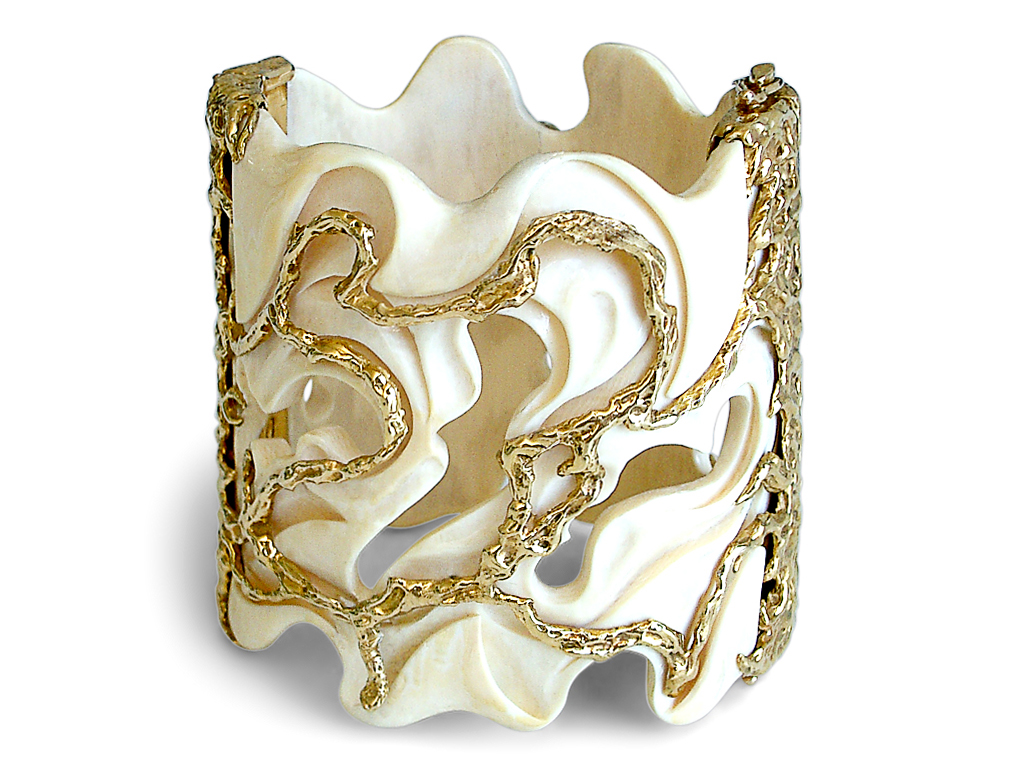
18k Gold and Ivory Bangle Bracelet


Wednesday, January 19, 2011

Aldo Cipullo


(1936-1984)

“All design is linked together.”

These are the words of renowned jewelry designer Aldo Cipullo. He began his apprenticeship in Italy, his home country, before moving to the States where he worked for David Webb and Tiffany. He even did time with Trifari designing costume jewelry. In the late sixties, a time of the flower child, he continued his career with Cartier, refining and simplifying his design sensibilities.

In 1969, he created what seemed like a fairly simple gold bracelet. Inspired by the chastity belt, he called his design the love bracelet and suggested that couples buy two, which they would exchange, like rings. They would each close the other’s circle with the screwdriver and never take off their bracelets. Cartier initially offered the bracelet exclusively to famous couples such as Elizabeth Taylor and Richard Burton, Nancy and Frank Sinatra. The love bracelet became so popular it is still a best seller at Cartier.

The nail bracelet, another iconic piece.


Detail of diamond and gold dollar sign bracelet, c.1970.

Ear pendants, 1972

This iconic piece underscored Cipullo’s more modernist eye and marked his trend to use the ordinary as inspiration for extraordinary pieces. The playful side of Cipullo led him to use everyday objects like nails, knots, dollar sign, and even games as the themes for his designs. For Cipullo, “to repeat the past is an easy way to get out of thinking, it’s an escape. The important thing is to reflect the present,” he says.

Little known Cipullo career move...jewelry designer on the 1973 movie “The Exorcist”. In this photo, actress Ellen Burstyn wears a Cipullo Hamsa necklace similar to the one pictured below.


Cipullo designs always turn heads...

Tuesday, January 18, 2011

History Lessons...

It was over 15 years ago that I bought my first piece of jewelry from the 1960's. This purchase developed a feverish passion for late mid-century fine jewelry. I wanted to show the world that modern design did not just come in silver. Gold Jewelry, so prevalent during both the 1960's and 70's, was big, bold and sculptural. It was a departure from the staid, mass produced pieces of earlier times. It reflected a new world, wild and individual. Major Jewelry houses employed designers to make one of a kind pieces to follow the success of Artist-Jewelers like Andrew Grima and Arthur King (whose shops incidentally, were as fantastic as their jewelry). The Beatles, Jimmy Hendrix, Vidal Sassoon, Mary Quant, Halston, Ed Sullivan, Flower Power, the Vietnam War - just a few components that influenced this wild 20 year span from 1960-1980. But is only in the past few years that this style has come back around. Forgotten names, at one time household with those in the know, have prompted me to share the information I have been gathering these last 15 years. I want to bring you more than just the wonderful collection of these artists on my website. I want to bring you a clearer sense of the pieces that were being made, the motivation behind the people making them, and of the time period in which they were produced.
In the future, I plan to look deeper into these artists:


Also:
Chaumet, John Donald, Mario Masenza, Asprey and Company, Buccellati, Toni Cavelti, Gubelin, Kutchinsky, Pierre Sterle, H. Stern, and more.

Get ready to have fun!

Monday, October 26, 2009

The Dark Side: Hidden Secrets of Art Nouveau Jewelry


Recently, Michael (my husband) and I had the good fortune to spend the day with jewelry author, jewelry historian, jewelry curator , Egyptologist, and mother, Yvonne Markowitz. It is not often I get to bend someones ear about jewelry for an entire afternoon. What a treat! We met at the Cincinnati Art Museum cafe at noon for lunch were we were introduced to Yvonne, a small women wearing an impressive silver necklace by Bjorn Weckstrom. Entitled "Planetaariset Laaksot" ("Planetary Valleys") ,the necklace is more commonly known as the Princess Leia necklace worn by Carrie Fisher in Star Wars Episode IV. I dressed in a little thing by Gilbert Albert - one of his hard to find gold,pearl and moldavite necklaces , (moldavite is a mossy-colored glass-like by- product that is produced when a meteorite hits the earth. ) We then raised our lightsabers....


Hers- as worn by Princess Leia


mine


When we exhausted all forms of jewelry conversation from ancient to modern, we excused Markowitz so she could prepare for her 2:00 lecture. My husband and I took a quick trip to the "Roaring Tigers, Leaping Carp" show. (More on this later) After seeing half of the show, we ran downstairs to procure a few good seats for a fantastic lecture on Art Nouveau Jewelry.

"Imperishable Beauty",currently on view at the Cincinnati Art Museum, is of the best Art Nouveau jewelry exhibitions to date. It is a stellar collection amassed by a private collector in the 60's and 70's. Although the collection is labeled private, we know that it comes from a friendly, yet formidable Doctor who exposed thousands of people to the wonderful world of jewelry . A passionate man that never tired of the hunt and was always ahead of the curve when it came to buying the most amazing things. We will all miss him. Luckily, his connoisseurship lives on and is enhanced by the expert of Yvonne Markowitz who speaks as enthusiastically about the collection as any collector. She talked about various pieces in the exhibit, pointing up techniques and inspirations. One of the most novel ideas she discussed was the importance of the reverse side of Art Nouveau jewelry. If you ever watch a jewelry expert handle a piece of jewelry you will notice a funny thing... they almost always look at the back first. This forensic study helps quickly evaluate a maker, a carat weight, repairs or most importantly , the quality of a piece. However, the flip side of many fine Art Nouveau jewels, take on a whole new meaning. Often pieces not only show the quality of craftsmanship , but also complete a picture. It is as if the jewel was practically meant to be reversible. But what inspired these artist-jewelers to so elaborately decorate a side that is so private? Markowitz suggests that love of all things Japanese during this time could be the answer...in particular,you guessed it... the Japanese netsuke!


Brooch by Rene Lalique, circa 1900
photo courtesy of
Woolley & Wallis Salisbury Salerooms Ltd


" Silent Cicada" ,Carved Cicada Netsuke contemporary, by Janel Jacobson

Top photo: Cicada Netsuke, carved wood, 19th Century
V & A Museum


Welcome


Hi Everyone,

Jewelry,Food,Art,Music,Fashion,Family,Friends...the stuff that makes up life (at least for me) is sometimes worth sharing. That's what this blog is essentially about. I don't profess to be a writer, scholar or a thinker. Just someone who for one reason or another feels like she "gets it". I invite anyone reading this to come along with me thru the soundbites of life and share their thoughts, ideas or comments.

I will write about jewelry- my passion of course. But food, art, fashion- (halloween) anything that gets me going and I think is share-worthy. The goal here is to enjoy life and the things it has to offer. I invite you to learn, teach and create.

*the watch posted above is 18k diamond and yellow gold, by Fred of Paris,circa 1970. The sculpture, unidentified artist, illegible signature, probably depicting Gargantua (see below)

Gargantua and Pantagruel

From Wikipedia, the free encyclopedia


Illustration by Gustave Doré, 1873

The Life of Gargantua and of Pantagruel (in French, La vie de Gargantua et de Pantagruel) is a connected series of five novels written in the 16th century by François Rabelais. It is the story of two giants, a father (Gargantua) and his son (Pantagruel) and their adventures, written in an amusing, extravagant, satirical vein. There is much crudity and scatological humor as well as a large amount of violence. Long lists of vulgar insults fill several chapters.

Rabelais studied Ancient Greek, and used this as he invented hundreds of new words, some of which became part of the French language.[citation needed] His quibbling and other wordplay fills the book, and is quite free from any prudishness.

The introduction to the series, in an English translation,[1] runs:

Readers, friends, if you turn these pages
Put your prejudice aside,
For, really, there's nothing here that's outrageous,
Nothing sick, or bad — or contagious.
Not that I sit here glowing with pride
For my book: all you'll find is laughter:
That's all the glory my heart is after,
Seeing how sorrow eats you, defeats you.
I'd rather write about laughing than crying,
For laughter makes men human, and courageous.

BE HAPPY!